

Introduction
Kevin Warsh’s first FOMC meeting might best be summarized by David Bowies iconic lyrics “Ch-ch-ch-ch-changes,” though I am pretty certain Bowie wasn’t referring to the Fed! The meeting marked one of the most significant shifts in Federal Reserve communications and monetary policy strategy since the Global Financial Crisis. Beyond maintaining interest rates, Warsh announced five task forces that could reshape how the Federal Reserve measures inflation, communicates with markets, manages its balance sheet, and evaluates economic data.
This article examines those initiatives, why they matter, and how they could influence financial markets in the years ahead.
Key Takeaways
- Warsh announced five major monetary policy initiatives.
- The Fed is moving away from forward guidance.
- Inflation measurement may evolve beyond traditional PCE.
- The balance sheet framework could change significantly.
- AI and new data sources may reshape future policy decisions.
Background Reading
If you need some background on the Fed and their tools to manage monetary policy, here are some articles GFMI wrote about the topics. Otherwise, feel free to skip ahead.
2015: “The Federal Reserve Tools: Past and Present”
2021: “The Federal Reserve Tools to Manage Monetary Policy”
2024: “The Federal Reserve’s Tools to Manage Monetary Policy in 2024”
Trump, Warsh, and Inflation
President Trump nominated Warsh on the premise that Warsh would lower interest rates. However, at Warsh’s first FOMC meeting he was facing much higher inflation than the Fed’s 2% target. The chart below shows headline inflation rates over the first five months of the year as well as inflation ex Food and Energy.
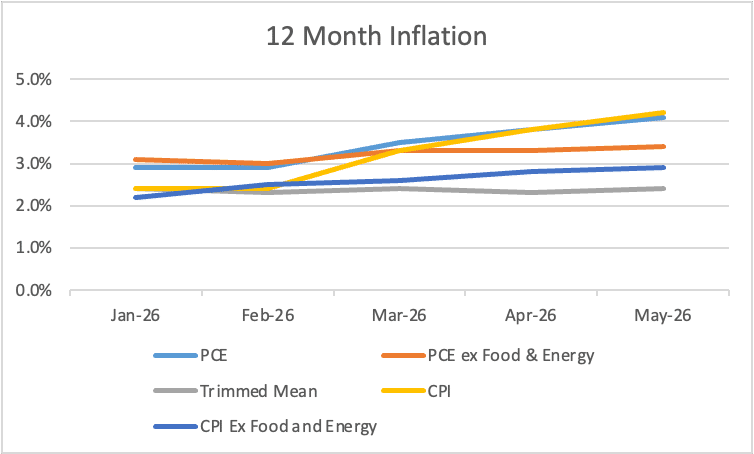
Note that I have used the Dallas Fed’s Trimmed Mean PCE as Warsh seems to believe this is a better inflation indicator than PCE, which had been the Fed’s preferred index. Refrain: Ch-ch-ch-ch-changes!!
What is Trimmed Mean Inflation? The Dallas Fed’s website gives an interesting analogy to the Winter Olympics:
“In spite of the arcane-sounding name, the concept of a trimmed mean is a simple one. In fact, trimmed means should be familiar to any follower of international figure skating. In the wake of the controversies surrounding the judging at the 2002 Winter Olympics, the International Skating Union adopted a scoring system in which a skater’s highest and lowest marks are discarded before the skater’s average score is calculated. Trimmed mean inflation rates are derived by a similar procedure.”1
They define The Trimmed Mean PCE inflation rate as “an alternative measure of core inflation in the price index for personal consumption expenditures (PCE).” Note the emphasis placed on “core inflation.”
Below are some features and observations of a trimmed mean:
- Throw out the highest and lowest observations resulting in a “trimmed” result.
- Based on the above, the resulting number should be in the middle of the distribution.
- Produces a smoother measure of underlying inflation.
- Often runs lower than core PCE when inflation is driven by broad-based shocks.
- Can understate inflation when many categories rise simultaneously (e.g., tariff-driven inflation).2
According to the Dallas Fed’s website: “The resulting inflation measure has been shown to outperform the more conventional ‘excluding food and energy’ measure as a gauge of core inflation.”1
There are critics of this indicator. “We think it is difficult to argue that the disinflation signaled by the trimmed mean is real,” wrote Standard Chartered Bank analysts Steve Englander and Dan Pan, noting not just the Dallas Fed measure’s statistical properties but also that it historically has not been as good at predicting future inflation as core PCE.2
Of course, time will tell how well this indicator performs as a Fed tool.
Federal Funds and Price Stability
Just a few short months ago, market participants were expecting the Fed to cut rates. But with inflation moving higher as a result of tariffs and the conflict in the Middle East, combined with President Trump’s desire for the Fed to lower rates, Warsh delivered the following at his first meeting:
“We recognize that inflation has been running well ahead of the Fed’s long-stated inflation goal of 2 percent that’s been going on for more than five years. Persistently high prices are a burden for the American people. But the recent past need not be prologue. I am pleased to report that members of the FOMC are unambiguous and unanimous: This Committee will deliver price stability.”3
To me, this sounded more like former Fed Chair Paul Volcker. When Volcker took office in 1979, CPI was approaching 12% and almost reached 15% in early 1980. Volcker was best known for:
- Aggressively fighting inflation by sharply tightening monetary policy;
- Allowing the federal funds rate to rise to nearly 20% in the early 1980s; and
- Triggering a severe recession in 1980–82, but ultimately reducing inflation from double-digit levels to around 3-4%, laying the foundation for decades of lower and more stable inflation.
An interesting historical note is that the monetary aggregates were released late Friday afternoons, when market participants didn’t have the ability to react since most markets were already closed. They became so important that the release of the numbers was changed to late Thursday afternoons!
Warsh’s opening remarks suggest that price stability—not political pressure to lower rates—will remain the Committee’s primary objective. Whether future policy actions reinforce that message remains to be seen. This will be crucial for the independence and integrity of The Fed.
Warsh’s Task Forces
In the Fed’s Press release, Warsh stated the following:
“Let me turn now to a few words on a key initiative that we’re announcing today. I’m appointing a task force in each of five areas that are central to the broad conduct of monetary policy: First, Fed communications; second, the Fed’s balance sheet; third, our use and reliance on existing data sources; fourth, productivity and jobs in an era of transformation; and last, the Fed’s inflation frameworks.”3
Let’s take a closer look at each of these initiatives.
Forward Guidance and Communications
According to the Federal Reserve’s website:
“Forward guidance is a tool that central banks use to tell the public about the likely future course of monetary policy. When central banks provide forward guidance, individuals and businesses can use this information in making decisions about spending and investments. Thus, forward guidance about future policy can influence financial and economic conditions today.”4
According to the transcript from Chair Warsh’s June 17 press conference, Warsh went on to say:
“…My Fed colleagues and I will be working in close collaboration to ask what changes might improve the conduct of monetary policy.
On that score, you might have already noticed something: a difference in today’s policy statement. It’s a bit shorter, a bit simpler—and it dispenses with some older language. That statement just gives you the facts, as best we can judge it. Absent, also, is so-called forward guidance—which we agreed was not well suited to the current policy conjuncture”3
In regard to the policy statement, the Wall Street Journal included a graph from the Federal Reserve in one of their articles showing the reduced verbiage:5

Why This Matters
This matters because forward guidance has been one of the Federal Reserve’s most influential policy tools over the past two decades. Removing it may increase market volatility immediately after FOMC meetings while forcing investors to rely more heavily on incoming economic data.
Potential Market Implications
- More market volatility after FOMC meetings
- Greater importance of economic releases
- Higher uncertainty regarding future rate paths
- Increased role for speeches by Fed officials
Balance Sheet Management
The Fed “…will review the benefits and risks of the current ample-reserves regime and the composition of the Fed’s balance sheet. They will assess alternative frameworks for the conduct and operation of monetary policy.”3
If the Federal Reserve continues reducing its balance sheet toward pre-pandemic levels, a larger share of Treasury issuance will need to be absorbed by private investors rather than the Fed. As a result, longer-term Treasury yields could rise, particularly if fiscal deficits remain elevated and investor demand does not keep pace with new issuance.
Why This Matters
Since the Global Financial Crisis, the Federal Reserve’s balance sheet has evolved from a relatively technical operational tool into one of its most powerful monetary policy instruments. Decisions about the size and composition of the balance sheet influence bank reserves, financial market liquidity, Treasury yields, and the overall availability of credit throughout the economy. Any changes to the Fed’s operating framework could therefore have significant implications well beyond the federal funds rate.
Potential Market Implications
- Higher Treasury term premiums
- Upward pressure on longer-term interest rates
- Reduced market liquidity
- Wider corporate credit spreads
- Increased competition for bank reserves
- Higher borrowing costs for businesses and consumers
Use and Reliance on Existing Data Sources
The third task force, the one on data, will evaluate new information sources and consider methodological changes to improve data gathering, with the aim of giving policymakers more accurate, relevant, contemporaneous, and, perhaps most important, actionable information on the state of our economy.3
The task force suggests the Fed is preparing to supplement traditional government statistics with more timely, private-sector and AI-assisted data. This appears promising but will the Fed create their own inflation index? Would this compromise their objectivity?
Chair Greenspan used a wide range of economic data. When he communicated, whether after a FOMC meeting or while addressing congress, he often mumbled and spoke in such a manner that most people had no idea what he was talking about! Let’s hope that any communication from Chair Warsh is clear and not arcane.
Why This Matters
The quality of the Federal Reserve’s decisions depends on the quality and timeliness of the data it receives. Traditional government statistics are often released weeks after economic activity occurs and are frequently revised. By incorporating new data sources and artificial intelligence, the Fed could gain a more current view of the economy, allowing policymakers to identify emerging trends sooner, thus responding more quickly to changing economic conditions.
Potential Market Implications
- Faster identification of inflationary or recessionary trends
- Greater use of private-sector and alternative data sources
- Increased application of AI to analyze large volumes of economic information
- More data-driven and potentially more responsive monetary policy
- Greater focus on real-time indicators rather than backward-looking statistics
Productivity and Jobs in an Era of Transformation
In his June 17 press conference, Chair Warsh continued: “Fourth, the task force on productivity and jobs. It’ll survey the pace, the reach, the economic impact of new general-purpose technologies, including AI, and explore the implications for the Fed in pursuit of our employment and inflation mandates.”3
How will the Fed evaluate GDP, productivity, and unemployment? Will the neutral interest rate change?
Warsh’s emphasis on productivity and AI naturally raises the question, if AI materially increases productivity growth, could the economy sustain higher interest rates without slowing?
Potential FOMC discussions on the topic might include:
- Credit card spending
- Payroll processors
- Shipping data
- Satellite imagery
- AI analysis
- Real-time housing rents
- Private inflation datasets
Why This Matters
Artificial intelligence and other emerging technologies have the potential to fundamentally change productivity, employment, and long-term economic growth. If these technologies enable the economy to grow faster without generating inflation, the Federal Reserve may need to rethink long-standing assumptions about the relationship between economic growth, employment, inflation, and interest rates.
Potential Market Implications
- A higher neutral interest rate (r*) if productivity growth accelerates
- Stronger long-term economic growth with lower inflationary pressure
- Changes in labor-market dynamics as AI alters the demand for different skills
- Reassessment of how the Fed measures maximum employment
- Possible changes in the timing and magnitude of future interest-rate adjustments
The broader question is whether artificial intelligence represents another incremental technological improvement or a structural shift comparable to the internet or electronification. If AI significantly increases productivity, it could reshape the Federal Reserve’s understanding of the economy, influencing everything from estimates of potential GDP and the neutral interest rate to the pace and direction of future monetary policy.
Fed’s Inflation Frameworks
Chair Warsh continued in his June 17 press conference, describing: “The last task force, the one on inflation frameworks, that’ll examine the drivers of inflation, first principles, and weigh the full range of ideas for delivering price stability in a changing economy.”3
Why It Matters
The Federal Reserve’s inflation framework determines how policymakers define inflation, which indicators they emphasize, and ultimately when they raise or lower interest rates. Even subtle changes to that framework can have significant implications for financial markets and the economy.
Potential implications include:
- Different inflation measures could lead to different policy decisions. If the Fed places greater emphasis on indicators such as the Dallas Fed’s Trimmed Mean PCE or develops new AI-enhanced measures, interest-rate decisions could differ from those based primarily on traditional PCE inflation.
- Changes in the framework could alter market expectations. Investors spend considerable time trying to anticipate future Fed actions. A revised inflation framework may require markets to reassess how they interpret inflation data and forecast future interest rates.
- The framework could affect the balance between inflation and employment. If policymakers conclude that structural changes, such as AI-driven productivity gains or shifting labor-market dynamics, have altered the economy, they may reassess how much inflation is acceptable before tightening monetary policy.
- Long-term interest rates and asset valuations could become more volatile during the transition. Whenever the Fed changes its analytical framework, markets typically require time to understand how policy decisions will be made under the new approach.
- Credibility remains paramount. Any new framework must convince investors, businesses, and consumers that the Federal Reserve remains committed to achieving price stability. The Fed’s credibility is one of its most valuable policy tools and maintaining that confidence will be essential regardless of how the framework evolves.
The broader question is not whether the Fed will adopt a new inflation measure, but whether it will rethink the way it evaluates inflation altogether. If the economy is changing because of artificial intelligence, evolving labor markets, and structural shifts in global trade, Warsh may believe that the framework developed after the Global Financial Crisis requires modernization. If so, this task force could ultimately prove to be the most consequential of the five initiatives.
Summary
The following table summarizes the five task forces, their primary purposes, and their anticipated market impacts:
| Task Force | Purpose | Market Impact |
| Communications | Simpler statements | Higher volatility |
| Balance Sheet | Reduce reserves | Higher yields |
| Data | Better real-time data | Faster policy shifts |
| Productivity | AI effects | Neutral rate uncertainty |
| Inflation Framework | New inflation measures | Different policy decisions |
Conclusion
Warsh’s first FOMC meeting suggests that the Federal Reserve is entering a new era. Rather than relying on increasingly detailed policy statements and forward guidance, the Fed appears poised to place greater emphasis on real-time data, clearer communication, and a reassessment of the frameworks developed following the Global Financial Crisis.
Whether these changes ultimately improve monetary policy remains to be seen. However, investors, banks, and regulators should pay close attention, not simply to future interest-rate decisions, but also to the evolving framework through which those decisions will be made.
References
1 https://www.dallasfed.org/research/pce/descr
3 https://www.federalreserve.gov/mediacenter/files/FOMCpresconf20260617.pdf
About the Author: Ken Kapner

Prior to starting GFMI in 1998, Ken spent 14 years with the HSBC (Hong Kong and Shanghai Banking Corporation) Group in their Treasury and Capital markets area where he traded a variety of instruments including interest rate derivatives, spot and forward foreign exchange, money markets; managed the balance sheet; sat on the Asset Liability Committee; and was responsible for the overall Treasury activities of the bank. He later headed up HSBC’s Global Treasury and Capital Markets Product training for two years in Hong Kong. Specifically, his responsibilities included developing new courses and delivering courses to traders, support staff and relationship managers. In New York, he established a training department for the firms’ Securities Division where he was in charge of the MBA Associates Program, continuing education and Section 20 license.
He has co-authored/co-edited seven books on derivatives including The Swaps Handbook and Understanding Swaps
Download article